Puritan & Revival Sermons
George Whitefield — the great open-air preacher of the Great Awakening — with Edwards, Spurgeon, Owen, Bunyan, and more, in full.
Hear them ›“Go ye into all the world, and preach the gospel to every creature.” — Mark 16:15
Street-preaching shirts, hoodies, banners, and signs — the gear that preaches before you ever open your mouth. Our shop is stocked by Shirts That Speak, makers of apparel for open-air preachers: when you buy, you buy from them, on their site — we simply point the way.
“I look upon all the world as my parish.”
“…in whatever part of it I am, I judge it meet, right, and my bounden duty to declare unto all that are willing to hear, the glad tidings of salvation.”
— John Wesley, on preaching in the open air, 1739
The pulpit God built first was outdoors. Jonah was sent to the streets of Nineveh; the prophets cried in the gates of Jerusalem; the Lord Jesus taught in the streets, on the hillsides, and from a boat; Paul reasoned in the market daily; and Whitefield drew thirty thousand at a time into open fields. This corner of the university belongs to that ministry: the charge of Scripture, the preaching itself, and the men of God who have done it.
Everything in the Corner, on one list — tap a name and go straight to it.
Brethren in the same work, on their own YouTube channels — tap a name and watch them preach. (Channels verified live, October 2026.)
George Whitefield — the great open-air preacher of the Great Awakening — with Edwards, Spurgeon, Owen, Bunyan, and more, in full.
Hear them ›Leonard Ravenhill, who preached in the streets of Leeds before he filled churches, with Reidhead, Washer, Tozer, and others.
Hear them ›This Corner keeps a roll of honour: the brethren of the open air who have finished their course and gone ahead of us, remembered here in their own preaching — for Scripture bids us render honour to whom honour is due.
“Render therefore to all their dues: tribute to whom tribute is due; custom to whom custom; fear to whom fear; honour to whom honour.” — Romans 13:7 (KJV)
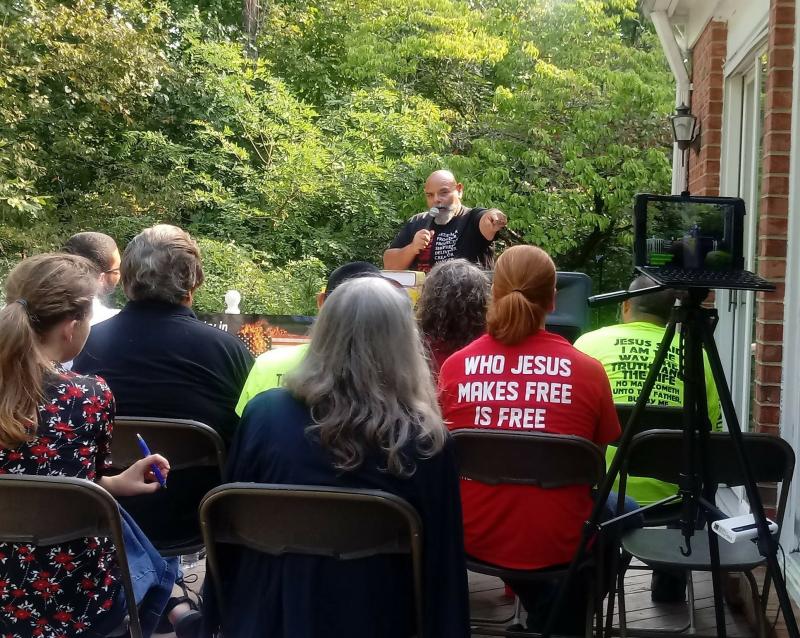
Photo: Santi Holley for Sojourners — Ruben preaching at SOAPA, September 2018
For some forty years, on the streets of America, there was a preacher who was bold as a lion. Born and raised in Los Angeles, California — his name was Ruben Israel, and this Corner keeps his memory.
Repentance was his theme. “Not one time, in the entire Book of Acts,” he said, “did those men preach ‘Jesus loves you.’ The theme has always been — in the Old Testament, to the Gospels, to the Book of Acts — repentance.” He called himself an equal opportunity rebuker, and in Salt Lake City he was still asking young men his famous question: “Can you give me the 10 commandments in order?” To every critic he answered with his text: a wicked generation, he said, needs cruel messengers — men sent to plant seeds that may not sprout for years.
And he carried that message everywhere — Mardi Gras in New Orleans, the Super Bowl, pride parades and campuses, year after year, post after post. Through a bullhorn in Jackson Square he cried, “This is your wake up call!” — and when a fortune-teller shouted “Call the cops!”, he answered, “If she was a real psychic, she would have had the cops here before we got here.” Bold, fearless — and laughing.
Ruben led the Bible Believers, a national company of street preachers, and he hosted the SOAPA conferences that trained them. He ran an outreach like a captain: “Stand here. Hold the banner like this. You preach now.” And men who agreed on little else stood shoulder to shoulder under his banners — for Ruben could unite them. “We can debate doctrine over dinner,” he would say. “Out here, we stand together.”
The law has his name on its books. At Dearborn, Michigan, in 2012, a hostile crowd pelted his team with bottles, and Ruben himself was struck in the face. The sheriff’s answer was to remove the preachers. Ruben sued — and the full U.S. Court of Appeals for the Sixth Circuit ruled in Bible Believers v. Wayne County (2015) that the county had violated their First Amendment rights, silencing them with a heckler’s veto. Every preacher who lifts his voice in America today works freer because Ruben Israel stood his ground.
At his last outreach, Ruben never took the bullhorn. He set every other man to preaching, and stood back — the captain, passing the torch. On June 24, 2023, the Lord took him home, at sixty-two. His family wrote that he was a dedicated servant of God, and that he rests now in God’s loving arms. He left an army behind him, still preaching.
These are the texts over his life:
“The wicked flee when no man pursueth: but the righteous are bold as a lion.” — Proverbs 28:1 (KJV)
“I have fought a good fight, I have finished my course, I have kept the faith:” — 2 Timothy 4:7 (KJV)
Hear him preach — these are the very recordings this university’s tribute film was cut from:
Venice Beach, 2017 — preaching Christ at the Hare Krishna parade: “Your life is but a vapor… Time to get serious about the God of the Bible.”
Mardi Gras, New Orleans — thirty years on Bourbon Street, and the word never changed: “Time for you to repent.”
His testimony — how the Lord took hold of him at eighteen, told by Ruben himself at a preachers’ conference.
More of the work: Dearborn, 2012 — the stand that became Bible Believers v. Wayne County · His advice to street preachers
Watch the work: Jesse Morrell’s documentary Ruben Israel – The Movie follows him from sunup to sundown on the streets of Los Angeles, and Ruben’s own preaching still fills YouTube:
Hold the banner up, brother, sister — and do not drop it. Honour to whom honour.
Pastor Noé was a Salvadoran preacher who carried the gospel through the streets of Tapachula, in southern Mexico. He preached Christ in the open air and brought the Word of God to people battling addiction. His own testimony was plain: “I do not preach a religion — I preach Christ the Lord.” Grace Team Seattle preached beside him in Tapachula’s central square, and stood with his ministry from 2021 to 2023.
In May 2026, Pastor Noé was detained by Tapachula’s municipal police. Hours later he was dead inside their base. The cause of his death has never been officially released, and as of the last reports (May 27, 2026) the investigation remains open. We set his name here because he was our brother in the work — and because his family still waits for the truth.
“I have fought a good fight, I have finished my course, I have kept the faith: Henceforth there is laid up for me a crown of righteousness, which the Lord, the righteous judge, shall give me at that day: and not to me only, but unto all them also that love his appearing.” — 2 Timothy 4:7–8 (KJV)
And hear him preach, from Grace Team Seattle’s own trips to Tapachula: People Repent in Tapachula, Mexico · The Fear of God Hits — 7 People Get Saved in Mexico
Rest in Christ, brother. Your voice is still preaching.
“And they that be wise shall shine as the brightness of the firmament; and they that turn many to righteousness as the stars for ever and ever.” — Daniel 12:3 (KJV)
Two full studies stand here in the Corner for the preacher’s own grounding: the history of the work he has taken up, and the prayer life that powers it.
From Noah to the modern street — God’s open-air preachers through all ages: who they were, what they did, whom they reached, and the Scripture pattern their open-air work followed.
Read the study ›The power a man carries into the street is made in the prayer closet — the Bible’s teaching on prayer, meditation, and seeking God’s face, proven in the lives of Daniel, E. M. Bounds, and George Müller.
Read the teaching ›Tracts are the street preacher’s seeds — left in hands, on benches, and at doors long after the voice is gone. The Corner’s one home for them gathers the whole tract catalog of Chapel Library (Mount Zion Bible Church, Pensacola, Florida), the Fellowship Tract League, and gospel stickers: browse by author or topic, tap a cover to read the tract, and request free printed copies.
Before a preacher opens his mouth on the corner, he is armed here. Epistemology settles how we know what we know; Soteriology settles the gospel itself — Christ died for the whole world; and the Defense of the Faith collection gives the positive proof, answers the objections, and refutes the cults out of their own books. The whole collection lives here in the Corner now — one home, under one roof.
The hub of the armory: the apologetics studies, the fifty answered objections, the refuted cults, and the Refutation Library — every study and every answered book, gathered in one place.
Enter the collection ›Eight studies of positive proof: the Bible is God’s Word, Jesus Christ is God, the Resurrection, salvation by grace alone, Christ died for the whole world, one way to God, creation and science, and how we got the King James Bible.
Enter ›How we know what we know: “The fear of the LORD is the beginning of knowledge” (Proverbs 1:7) — the foundation under every answer the preacher gives.
Study ›The doctrine of salvation, taught the Baptist way — with Dr. Leighton Flowers’ Soteriology 101 collection, answering the Calvinist system text by text.
Study ›Fifty questions skeptics ask about God, the Bible, and Christianity — each one stated the way the skeptic states it, and each one answered from reason and the King James Bible.
Read the answers ›The deepest arguments against Christianity, stated the way the skeptic states them — and every one answered: tap a question and watch the answer given face to face, with the refutation from the King James Bible written beneath it.
Give the answer ›The counterfeit kingdoms under one banner: the Marks of a Cult, then the groups — Islam, Mormonism, Jehovah’s Witnesses, Roman Catholicism, Christian Science, Oneness Pentecostalism, and Unitarianism — their teaching stated honestly, then refuted from Scripture, with the book behind the name honored at the door.
Enter ›The street preacher’s keyword study — a bank of keys, each one a word or phrase of Scripture, counted from the Bible itself and hung with the verses that preach it. Tap a key and its Scriptures drop down on the spot — built for a man standing on a sidewalk with a soul in front of him.
Open the Bank ›The cults are known by their books: the Quran, the Book of Mormon, the Pearl of Great Price, the Doctrine and Covenants, Science and Health, the Bhagavad Gita, the Dhammapada, and the Tao Te Ching — opened, searched, and answered.
Enter the Library ›A man does not learn to fence by reading about swords. Here the preacher trains before he stands on the corner — the Word learned by its key words, the verse known by heart, the answer ready before the question is finished. The games built for the open-air man are gathered on their own ground, through one door.
The gathering place of the preacher’s own training: the Key Bank armory and the games built specifically for street preachers — Find the Key Verse, Preach the Verse, Two Witnesses, and Heckler Mode. Enter, be proved, and leave readier than you came.
Enter the Training Ground ›The deep end of the training ground — the simulations built for the man who preaches in the open air. Answer the heckler out of the Scriptures, preach the verse from your heart with no page between you and the soul in front of you, know a true witness from a stranger, and walk the roads of the men who preached before you. This is training for the street, and it does not go easy on you.
The Corner’s own proving ground, through one door — the Key Bank armory and the games built specifically for street preachers, gathered in one place.
Enter ›A heckler in the crowd shouts an argument against the faith — and four verses stand before you. Only one of them is the verse that answers him. Strike back with that verse, against the clock: the crowd does not wait.
FIVE LEVELS — Babes · Novices · Ministers · Masters · Hey Moses
Enter ›A reference is called, and nothing else — no text, no passage around it, no hints. Preach the verse from its reference alone, word for word, as if a soul on the street just asked you for it.
FIVE LEVELS — Babes · Novices · Ministers · Masters · Hey Moses
Enter ›A theme of Scripture is named, and two verses stand before you as its witnesses. One truly testifies to it; the other is a stranger wearing its clothes — near in sound, foreign in substance. Tell the true witness from the stranger.
FIVE LEVELS — Babes · Novices · Ministers · Masters · Hey Moses
Enter ›A key word is named, and verses stand before you: tap every verse that belongs to that key, and leave the strangers standing. Command of the very verses that answer the street’s questions, trained on the Key Bank itself.
FIVE LEVELS — Babes · Novices · Ministers · Masters · Hey Moses
Enter ›The armory beneath the training: 248 key words of Scripture, counted from the Bible itself, each one hung with the verses that preach it — the verse you need, in your hand in seconds, with a soul standing in front of you.
Enter ›The words behind the Word: 217 Greek words of the New Testament. Study each band — meaning, definition, and the verse the word stands behind — then be drilled on it until every word in your set is mastered.
FIVE LEVELS — Babes · Novices · Ministers · Masters · Hey Moses
Enter ›Walk the apostle Paul’s road station by station, from the light outside Damascus to Rome, choosing at every crossroads the path he actually took — then drill the very order of his journeys in The Next City.
FIVE LEVELS — Babes · Novices · Ministers · Masters · Hey Moses
Enter ›Walk the lawgiver’s whole road, from the Nile to Nebo, choosing at every crossroads the path Moses took — the road Scripture records, hard parts and all, nothing tidied away.
FIVE LEVELS — Babes · Novices · Ministers · Masters · Hey Moses
Enter ›“Thy word have I hid in mine heart, that I might not sin against thee.” The memorization simulator: a verse of Scripture stands before you with the clock beside it — then it vanishes, and you must speak it back from memory, graded word by word. A thousand of the most important verses in the Book; the level is the memorization clock, from ninety seconds down to fifteen.
FIVE LEVELS — Babes · Novices · Ministers · Masters · Hey Moses
Enter ›The positive case for the Christian faith, study by study — every claim tried by the Scripture itself. The eight studies stand here in full, where the preacher is armed for the street.
The Bible does not merely contain the word of God — it is the word of God. Its inspiration is plenary (every part) and verbal (the very words), and God has preserved what He inspired.
Paul states the fact plainly: all Scripture is given by inspiration of God. Peter adds that holy men of God spoke as they were moved by the Holy Ghost — the writers were carried, not inventing.
The words of the LORD are pure words, and He promised to keep them from this generation for ever. Heaven and earth will pass away; His words will not.
Jesus Himself treated the written Word as unbreakable authority and built arguments on single words of it. The Bible's own testimony about itself is consistent from Genesis to Revelation.
The deity of Christ is not a church invention — it is the plain teaching of Scripture, claimed by Jesus Himself and confessed by His apostles.
John opens his Gospel by identifying Jesus as the eternal Word who was with God and was God, and who was made flesh and dwelt among us.
When Jesus said 'Before Abraham was, I am,' His hearers took up stones — they understood He had claimed the name God gave Moses at the burning bush.
Thomas confessed Him 'My Lord and my God,' and Jesus received the confession. Paul writes that in Him dwells all the fulness of the Godhead bodily, and the Father Himself addresses the Son as God.
Christianity stands or falls with the empty tomb. Paul stakes the whole faith on it: if Christ is not risen, our preaching is vain. He is risen — and the evidence was public, early, and examined.
Christ died for our sins according to the Scriptures, was buried, and rose again the third day according to the Scriptures — the gospel Paul preached is exactly what the prophets foretold.
He was seen of Cephas, of the twelve, of above five hundred brethren at once, of James, and last of Paul — an enemy of the faith converted by the risen Christ.
Because He lives, death is not the end for those in Christ: He is become the firstfruits of them that slept, and our labour is not in vain in the Lord.
No cult, no religion of works, and no sinner can add anything to the finished work of Christ. Salvation is a gift — received by faith, never earned by merit.
By grace are ye saved through faith — not of works, lest any man should boast. If it is by grace, it is no more of works; the two cannot be mixed.
All have sinned, and all who believe are justified freely by His grace through the redemption that is in Christ Jesus — a man is justified by faith without the deeds of the law.
By one offering He hath perfected for ever them that are sanctified. Nothing remains to be added — not purgatory, not probation, not our own righteousness.
Grace Team University teaches, without apology and without the Reformed system, what the Scripture says in plain words: Jesus Christ died for the sins of the whole world. God wills all men to be saved; the ransom was paid for all; the grace that bringeth salvation hath appeared to all men; election is according to God's foreknowledge; and men perish, not because Christ did not die for them or because grace could not be resisted, but because they will not come. This study sets out the doctrine in detail and answers the Calvinist proof-texts one by one.
John the Baptist announced Him as 'the Lamb of God, which taketh away the sin of the world' (John 1:29) — the world, not a favoured fragment of it. John the apostle closes the question: 'he is the propitiation for our sins: and not for ours only, but also for the sins of the whole world' (1 John 2:2). Paul writes that Christ 'gave himself a ransom for all' (1 Timothy 2:6), that God is 'the Saviour of all men, specially of those that believe' (1 Timothy 4:10), and that 'one died for all' (2 Corinthians 5:14). Hebrews says He tasted death 'for every man' (Hebrews 2:9). Isaiah saw it coming: 'the LORD hath laid on him the iniquity of us all' (Isaiah 53:6). The Reformed doctrine of a limited atonement requires every one of these verses to mean less than it says.
The God who 'will have all men to be saved' (1 Timothy 2:4) is 'not willing that any should perish, but that all should come to repentance' (2 Peter 3:9). 'For God so loved the world, that he gave his only begotten Son, that whosoever believeth in him should not perish' (John 3:16). Paul draws the parallel as wide as the fall: as judgment came upon all men, 'even so by the righteousness of one the free gift came upon all men unto justification of life' (Romans 5:18). Christ promised, 'I, if I be lifted up from the earth, will draw all men unto me' (John 12:32), and the grace of God 'hath appeared to all men' (Titus 2:11). A gospel that must be preached to every creature (Mark 16:15) is honest only if it was purchased for every creature.
The hardest verse in the Bible for limited atonement: false teachers arise 'denying the Lord that bought them, and bring upon themselves swift destruction' (2 Peter 2:1). These men are bought by the Lord and yet damned — bought, and perishing. If Christ's death purchased only the elect, this verse is impossible; if He died for all, it is plain. The price was paid for every man; the benefit is received by those who believe. A ransom paid is not a ransom applied, and Scripture never confuses the two.
Where the Bible explains election, it explains it by foreknowledge: 'Elect according to the foreknowledge of God the Father' (1 Peter 1:2). Romans 8:29 puts the order in a single sentence: 'whom he did foreknow, he also did predestinate to be conformed to the image of his Son.' Foreknowledge stands first; predestination follows it, and what believers are predestinated to is conformity to Christ and final glory — not a bare decree selecting who may believe. Ephesians 1:4 says God 'hath chosen us in him' — the choosing is IN Christ: God chose the place, the Person, and the plan, and men enter it by faith. Nowhere does Scripture teach an unconditional election that passes by the willing and drags the unwilling.
From the beginning, 'My spirit shall not always strive with man' (Genesis 6:3) — He strives, and striving can end. The Spirit's office is to 'reprove the world of sin, and of righteousness, and of judgment' (John 16:8) — the world. Yet Stephen charged Israel, 'ye do always resist the Holy Ghost' (Acts 7:51). Jesus wept over a city He would gladly have gathered: 'how often would I have gathered thy children together... and ye would not!' (Matthew 23:37), and told the unbelieving plainly, 'ye will not come to me, that ye might have life' (John 5:40). The Reformed doctrine of irresistible grace cannot survive these verses read at face value; the Baptist doctrine of a God who calls, strives, and can be refused, can.
John 6:44 — 'No man can come to me, except the Father... draw him.' True: men come only as the Father draws — and Christ Himself defines the drawing: 'I... will draw all men unto me' (John 12:32), and the next verse in John 6 explains the mechanism: 'Every man therefore that hath heard, and hath learned of the Father, cometh unto me' (John 6:45). Drawing is by the word heard and learned, and it is for all. — John 10:26 — 'ye believe not, because ye are not of my sheep.' Read Christ's order in the same chapter: His sheep are those who hear His voice and follow (John 10:27); unbelief is the reason given throughout ('ye will not come'), not a secret decree. — Acts 13:48 — 'as many as were ordained to eternal life believed': the same chapter shows men 'judging themselves unworthy of everlasting life' by refusing the word (Acts 13:46); the ordained are those disposed and appointed by their own hearing of it, glad and glorifying the word (13:48). — Romans 9 — Jacob and Esau are nations in the passage itself (Genesis 25:23, 'two nations'), God's freedom in choosing instruments and nations for His purpose in history; and the chapter ends not with a decree of damnation but with this: whosoever believeth on Him shall not be ashamed (Romans 9:33; 10:11, 13).
In an age that says all roads lead to heaven, Jesus says the opposite about Himself — and the apostles preached the same exclusivity at the cost of their lives.
He did not say He shows the way; He said 'I am the way.' No man comes to the Father but by Him.
Peter, filled with the Holy Ghost, told the rulers of Israel there is salvation in none other — no other name under heaven given among men.
Wide is the gate that leads to destruction, and many go in thereat; strait is the gate that leads to life. The issue is not sincerity but direction — which road a man is on.
True science and the Bible are not enemies. The Bible spoke of the earth's suspension, the water cycle, the springs of the sea, and the life in the blood centuries before men measured them. (Our full 'Science and the Bible' teaching is in production.)
In the beginning God created the heaven and the earth. The heavens declare His glory to every honest observer.
Job says God hangeth the earth upon nothing, and describes the rain cycle; Isaiah speaks of the circle of the earth; Moses recorded that the life of the flesh is in the blood.
The wrath of God is revealed against those who hold the truth in unrighteousness — the evidence of His eternal power and Godhead is clearly seen in the things that are made, so men are without excuse.
God not only inspired His Word; He preserved it. This is the short account — a full teaching video, 'How We Got the King James Bible,' is in the teaching queue.
The Hebrew Scriptures were kept by the Masoretes with extraordinary care, and the Greek New Testament was copied and spread by the churches. God's promise was to preserve His words — and He did.
Wycliffe's hand-written Bible (1380s) gave England the Scriptures; William Tyndale printed the New Testament in 1525–26 and sealed his testimony with his life in 1536. The Geneva Bible (1560) carried the Reformation across the English-speaking world.
At the Hampton Court Conference (1604), King James authorised a new translation. About forty-seven of England's finest scholars, in six companies at Westminster, Cambridge, and Oxford, worked under fifteen strict rules for four years, comparing the Hebrew and Greek and the earlier English versions. The Authorised Version was published in May 1611 — formally equivalent, reverently translated, and proven by four centuries of fruit.
Defense of the Faith › · Kingdom of the Cults ›
The banner preaches before the preacher ever opens his mouth — it preaches to the whole street at once, to the ones who will not stop, and to the ones who only pretend not to read it as they pass. These are the banners and signs of this work, carried as found: Matthew’s own banners first, then the black banners of Ron Cardiel. Tap any banner to open it on its own page, full size, ready to print.
Matthew's great Bible banner in its filled edition — the whole sweep of Scripture, every book, era, and turning point of the Bible's story, drawn as one long panoramic timeline, made for teaching at a glance.
Matthew's companion banner on the last book of the Bible — the visions of Revelation as one sweeping panoramic chart: the churches, the seals, the trumpets, the vials, and the coming of the King, laid out in order for teaching and for preaching.
The banner’s words: REVELATION: THE END TIMES
The hell side of Matthew's two-sided 5′×8′ street banner — the question that stops the crowd, with the answer carried in the verse beneath it. (BlueWave order, October 2026.)
The banner’s words: ASK ME WHY YOU DESERVE TO BURN IN HELL — “For the wages of sin is death; but the gift of God is eternal life through Jesus Christ our Lord.” — Romans 6:23 (KJV)
The promise side of the same two-sided 5′×8′ banner — scarlet sins made white as snow, and the only way to God named plainly: Jesus Christ. (BlueWave order, October 2026.)
The banner’s words: THOUGH YOUR SINS BE AS SCARLET, THEY SHALL BE AS WHITE AS SNOW; JESUS CHRIST IS THE ONLY WAY TO GOD — REPENT AND BELIEVE THE GOSPEL TODAY — Isaiah 1:18 (KJV)
Ron Cardiel preaches with Gospel Invasion Ministries. His banners are the black ones — white letters, one text of Scripture, readable a block away. They are shown here as they stand in Matthew’s photographs and footage of their preaching together.
Ron Cardiel (right, holding the pole) with his black banner on the street at night, preaching with Matthew and Justin. Ron's banners are the black ones — white letters and one text of Scripture, readable a block away.
The banner’s words: BORN AGAIN. — John 3:7 (the panel beside it reads “…Wrath to Come” — Matthew 3:7)
Ron preaching Christ at Salmon Days in Issaquah, the black banner standing over him in the middle of the crowd — the same Born Again banner in daylight. Part of the banner stands behind the video's own Scripture captions; what is written on it is carried in the words line below.
The banner’s words: Repent & Believe the Gospel — JESUS SAID: YOU MUST BE BORN AGAIN. — John 3:7
One of the black banners carried on the street in Portland — white, green, and red letters on black: only Jesus saves from hell.
The banner’s words: ONLY JESUS SAVES FROM HELL
Walk through the tabernacle station by station: enter the outer court and come first to the bronze altar, where the sacrifices were offered, and the laver, where the priests washed. Pass through the door into the Holy Place — the lampstand giving its light, the table of shewbread, and the altar of incense before the veil. Then through the veil into the Holy of Holies, where the Ark of the Covenant rests beneath the mercy seat. Every piece of it preaches Christ: “the tabernacle, and all that is therein” was made after the pattern — and the pattern points to Him (Exodus 25:40; Hebrews 8–9).
Before the preaching comes the proving. These debates and campus sessions put the resurrection, the existence of God, and the origin of life on the table before skeptics — Craig, Knechtle, Turek, Cameron, and Comfort — so the street preacher can watch the arguments made, tested, and answered.
The flagship resurrection debate — William Lane Craig vs. Bart Ehrman, “Is There Historical Evidence for the Resurrection of Jesus?” (College of the Holy Cross, 2006).
Cliffe works through the eyewitness evidence for the risen Christ with students — the 1 Corinthians 15 creed and the five hundred witnesses.
The famous 2009 Biola debate — cosmology, design and origins, morality, and the resurrection all in play.
Craig vs. the Caltech cosmologist on the origin and fine-tuning of the universe (Greer Heard Forum, 2014).
Craig vs. Sam Harris at the University of Notre Dame (2011): “Is Good from God?”
Give Me An Answer #2114: Cliffe’s flagship answer to the problem of evil and suffering.
Father-and-son open-air Q&A on the MIT campus — evolution, morality, and the ground of the good.
A classic Cliffe campus session: his four pieces of evidence for God, and the student pushback.
Campus dialogue on sex, guilt, and grace — real student questions, answered from Scripture.
Cliffe presses students on truth, belief, and the resurrection as the test of whether faith matches reality.
Turek vs. Hitchens at Virginia Commonwealth University (2008) — the arguments for God’s existence, origins included.
Turek vs. skeptic publisher Michael Shermer — origins, design, and morality as competing explanations of reality.
The 2015 Stony Brook rematch with Shermer, on whether God or science better explains morality.
UT Dallas campus Q&A — the moral argument, the “uncaused universe,” and the objection of hell, answered live.
The ABC Nightline “Face-Off” at Calvary Baptist Church, Manhattan, moderated by Martin Bashir — presented here in the Rational Response Squad’s own official upload of the broadcast.
The full film (Living Waters): Comfort interviews UCLA and USC professors and students and presses for observable evidence for Darwinian evolution.
The full 33-minute “180” film (Living Waters) — the one question that turns hearts on abortion, by way of the gospel.
Shirts that preach before you open your mouth, and the field gear that keeps a preacher heard and standing — speakers, microphones, stands, cameras, rain gear, Bibles, and free Gospel tracts, gathered in the university shop.
Get Your Preaching Gear ›